Survey-weighted Functional on Scalar Regression
svyfui.RdA high-level wrapper for running survey-weighted function-on-scalar regression with bootstrap inference.
Usage
svyfui(
  formula,
  data,
  weights = NULL,
  family = gaussian(),
  boot_type = "weighted",
  num_boots = 500,
  nknots_min = NULL,
  nknots_min_fpca = NULL,
  seed = 2025,
  conf_level_pw = 0.95,
  conf_level_joint = 0.95,
  verbose = TRUE,
  parallel = FALSE,
  n_cores = NULL,
  ...
)
Arguments
- formula
Formula with functional outcome on predictors, e.g.
Y ~ X1 + X2.- data
A data frame with functional outcome columns, predictors, weights, etc.
- weights
Optional bare column name for weights or external weight vector
- family
Outcome distribution family (e.g., "gaussian", "binomial").
- boot_type
Bootstrap method: "BRR", "Rao-Wu-Yue-Beaumont", "weighted", "unweighted".
- num_boots
Number of bootstrap replicates.
- nknots_min
Minimum number of knots for smoothing (optional).
- nknots_min_fpca
Minimum number of knots for FPCA (optional).
- seed
Random seed for reproducibility.
- conf_level_pw
Confidence level for pointwise confidence intervals (default 0.95).
- conf_level_joint
Confidence level for joint confidence intervals (default 0.95).
- verbose
Whether to print messages about progress
- parallel
Whether to run bootstrap in parallel (default FALSE).
- n_cores
Number of cores to use if parallel = TRUE
- ...
Additional arguments passed to helpers.
Value
A list with components:
- betaHat
Smoothed coefficient functions
- cis
Bootstrap confidence intervals
- boots
Raw bootstrap draws of coefficients
- tidy_df
Tidy data frame for plotting with columns
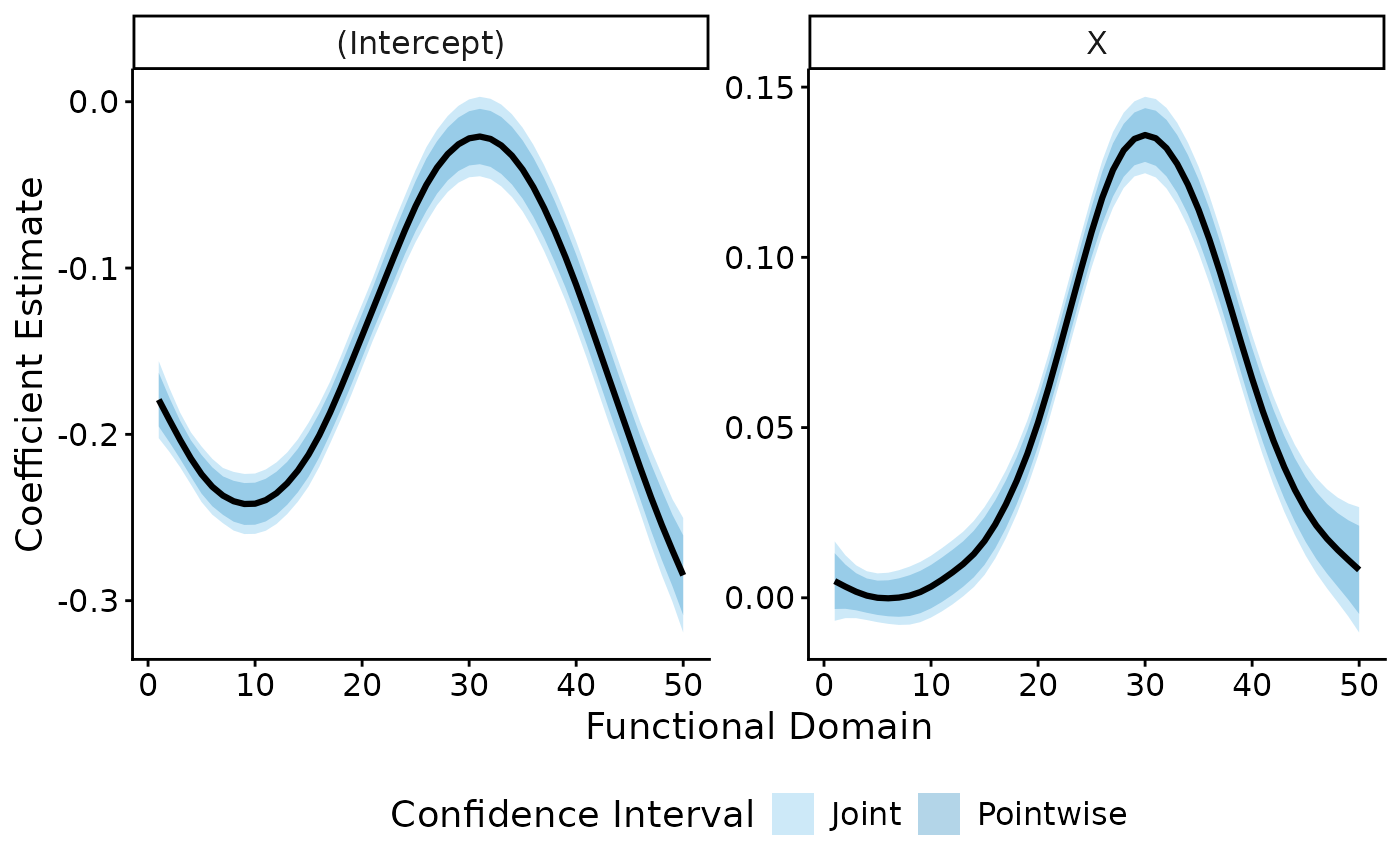
l(functional domain),beta_hat(estimate),lower_pw(pointwise lower CI),upper_pw(pointwise upper CI),lower_joint(joint lower CI),upper_joint(joint upper CI), andvar_name(variable name from regression)